

While the number of publicy-traded companies in the U.S. continues to contract, and IPO activity has slowed substantially in recent years, 2026 promises to be the year of the mega IPO, with three large companies with a combined valuation of more than $3.5 trillion going public.[i]
Space Exploration Technologies (SpaceX) kicked things off, by going public on June 11, with OpenAI, and Anthropic planning to go public this fall.
The combined size of these IPOs is unlike anything we’ve ever seen. Previously, the world’s largest IPO was Saudi Aramco, which raised $25.6 billion at a $1.7 trillion valuation in 2019. SpaceX has a similar valuation of about $1.7 trillion, but will raise of up to $75 billion (based on $135 per share).[ii]
As the chart below shows, SpaceX’s valuation is approximately equal to the 14 largest companies in the aerospace sector, including Boeing, Airbus, and GE Aerospace
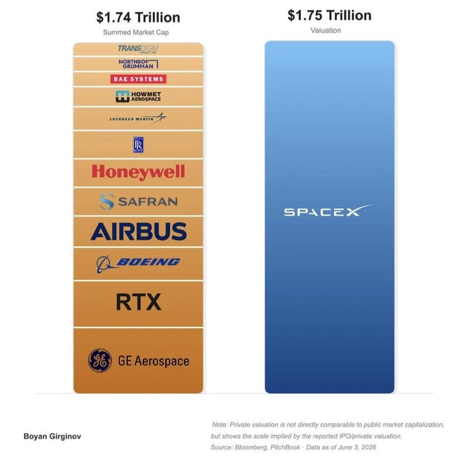 This valuation makes SpaceX the seventh largest public company in the U.S. after another Elon Musk company, Tesla, at eighth largest. At their current valuations, Anthropic ($965 billion) and OpenAI ($852 billion) would both rank among the top 15 most valuable U.S. publicly traded companies.[iii]
Many investors will be clamoring to get early access to shares of these companies. In the short term, shares often rise following an IPO, allowing insiders and the lucky few who get access to make a handsome profit.
Historically, one of the drivers of stock prices for IPOs has been inclusion in popular indices, such as the S&P 500, that are tracked by index funds. Usually, inclusion in an index involved an often lengthy waiting period. However, a number of indices have indicated that they will be “fast tracking” mega IPOs.
CRSP, Russell, S&P Down Jones indices have all announced that they will be including mega-IPOs after five trading days, MSCI will be including them after 10 days, and Nasdaq after 15 days.[iv] For now, the S&P 500 has decided to stick to its policy of requiring 12 months of public trading and positive earnings across four quarters.
By one estimate, many money managers, including index fund managers, will need to buy $14.2 billion of SpaceX stock by July 4, just to appropriately market weight it in their portfolios—without even taking a stance, pro or con, on its prospects.[v]
This will probably create short-term price spikes, as index funds are usually required to buy these stocks when they join the index, regardless of price. This is often referred to as the "index inclusion premium.”
While Symmetry and the money managers we work with do not believe in market timing or speculation, we do believe in evidence-based investing. If the data and evidence suggest that it makes sense to add SpaceX—or any of these other mega IPOs—to a portfolio, we think it makes sense to wait until short-term price spikes have subsided.
Which leads to the larger question: Is SpaceX worth its IPO valuation of $135 a share? Should investors try to snap it up quickly? What about the other mega IPOs when they go public?
Certainly, from a fundamentals perspective, there are many questions. The price-to-sales ratio for SpaceX (a measure of a stock’s price in relation to its annual sales) is incredibly high—SpaceX had $18.7 billion in revenue last year, while still losing $4.9 billion.[vi] Its current soaring valuation is based on the assumption that sales will accelerate significantly beyond past levels. Morningstar, after careful analysis, values the stock at a more earthbound $63.[vii]
In addition, IPOs tend to underperform after the hype dies down.
On average, the 30 largest IPOs in the Russell 3000 Index over the past 20 years (through 2025) underperformed the S&P 500 by roughly 15% during their first year of trading.[viii]
The situation is even worse for mega IPOs. As the chart below shows, a year on, recent mega IPOs returned an average of -28.4%.
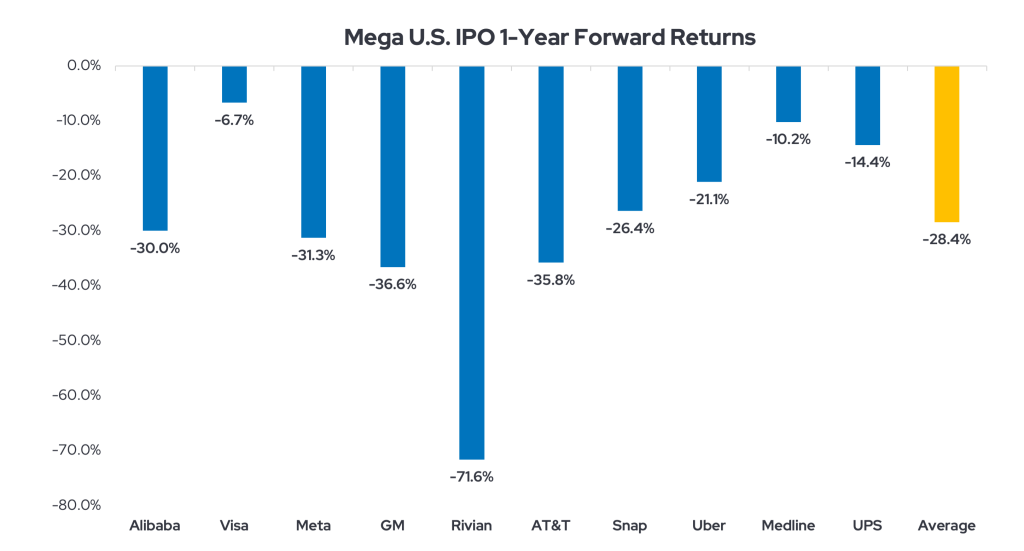
Source: Envestnet
During periods of heightened market excitement like this, we believe it’s important to stay grounded—focusing on data rather than emotion. An evidence-based approach can help investors navigate environments like mega IPOs while avoiding common behavioral pitfalls such as chasing performance or reacting to short-term noise. While mega IPOs may or may not be sound investments at some point in the future, the data suggests that investors should be in no hurry to add them to their portfolios.
As always, Symmetry’s experts are here to help you apply disciplined, data-driven strategies designed to support more consistent, long-term outcomes. Connect with us to learn more.
[ii] www.investing.com/analysis/the-largest-public-offering-in-history-spacex-ipo-comes-with-a-stratospheric-risk-200681913
[v] Ibid
[vi] Ibid
[viii] Edward Jones
About Symmetry Partners
Symmetry Partners LLC was founded in 1994 by financial advisors for financial advisors. The firm offers a comprehensive range of investment solutions, including High-Net-Worth wealth strategies. To help advisors deliver a better client experience, we also provide marketing, technology, and operational consulting and support.
Symmetry Partners, LLC is an investment advisory firm registered with the Securities and Exchange Commission (SEC). The firm only transacts business in states where it is properly registered, excluded, or exempt from registration requirements. Registration of an investment adviser does not imply any specific level of skill or training and does not constitute an endorsement of the firm by the SEC.
No one should assume that future performance of any specific investment, investment strategy, product, or non-investment-related content made reference to directly or indirectly in this material will be profitable, equal any corresponding indicated historical performance level(s), be suitable for your portfolio or individual situation, or prove successful. You should not assume any discussion or information contained in this material serves as the receipt of, or as a substitute for, personalized investment advice. Symmetry does not provide tax or legal advice and nothing either stated or implied here should be inferred as providing such advice. Due to various factors, including changing market conditions and/or applicable laws, the content may no longer be reflective of current opinions or positions.
Diversification seeks to improve performance by spreading your investment dollars into various asset classes to add balance to your portfolio. Using this methodology, however, does not guarantee a profit or protection from loss in a declining market. Past performance does not guarantee future results.
Stock markets are volatile and can fluctuate significantly in response to company, industry, political, regulatory, market, or economic developments. Investing in stock involves risks, including the loss of principal.
Foreign markets can be more volatile than U.S. markets due to increased risks of adverse issuer, political, market, or economic developments, all of which are magnified in emerging markets. These risks are particularly significant for investments that focus on a single country or region.
The energy industries can be significantly affected by fluctuations in energy prices and supply and demand of energy fuels, energy conservation, the success of exploration projects, and tax and other government regulations.
All indexes have certain limitations. Investors cannot invest directly in an index. Indexes have no fees. Historical performance results for investment indexes generally do not reflect the deduction of transaction and/or custodial charges or the deduction of an investment management fee, the incurrence of which would have the effect of decreasing historical performance. Actual performance for client accounts may differ materially from the index portfolios.